
About
Kazakhstan’s academic HPC centre
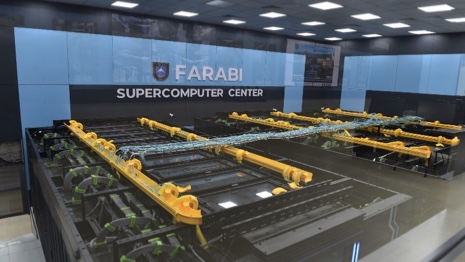
The Farabi Supercomputer Center was created through strategic cooperation between the Republic of Kazakhstan and the People’s Republic of China under intergovernmental agreements to develop scientific and technological infrastructure.
Under this cooperation, China provided high-performance computing equipment on a grant basis. For its part, al-Farabi Kazakh National University fully funded construction of a modern Tier II data center that keeps the supercomputer complex running reliably.
Establishing the Farabi Supercomputer Center was an important step in building Kazakhstan’s digital scientific infrastructure. It laid the foundation for world-class domestic research, training of highly qualified specialists, and the adoption of artificial intelligence in the economy and public administration.
Peak Performance
CPU Compute Nodes
NVIDIA A10 Accelerators
Storage
InfiniBand Network
National context
A national facility for science and AI
Today the Farabi Supercomputer Center operates as open national research infrastructure. It hosts projects in artificial intelligence, climate modelling, geoinformation technologies, big data processing, bioinformatics, digital medicine, industrial machine vision, modelling of physical processes, and other scientific fields. The centre works actively with government bodies, universities, research institutes, and industrial enterprises, giving them access to modern computing resources.
In practice
Where the machines are used
National AI work, climate science, genomics, city systems, and hazard modelling already run here.
Kazakh-language AI
GPU and HPC time for Kazakh-language model development — a stated national priority.
Climate & Earth science
Weather and climate modelling, remote sensing, and environmental studies for agencies and university labs.
Genomics & life sciences
From sequencing prep to genome analysis for biomedical and biology groups.
Smart City Almaty
Capacity suited to video analytics and situational-centre workloads for Almaty’s Smart City programmes.
Hazards & early warning
Joint modelling of natural and industrial hazards with emergency and seismology partners.
AI, ML & Big Data
Training, large-scale data jobs, and inference for universities, startups, and enterprises.
Facility
A campus data centre, not a brochure
Tier II academic data centre: dense racks, InfiniBand, Intel CPUs and NVIDIA GPUs. Listed among the world’s top 600 systems.
~2 PFLOPS peak
Roughly 2,000 teraflops peak — enough that multi-year workstation jobs can finish in hours.
CPU + GPU stack
Hundreds of CPU nodes, NVIDIA A10 GPUs, and petabytes of storage for mixed HPC and AI work.
Remote access
Accounts and institutional agreements so teams outside Almaty can use the cluster without relocating.

Leadership
Amirkhan Temirbayev
Director, Farabi Supercomputer Center
He leads the development of the Farabi Supercomputer Center as modern scientific and technological infrastructure of al-Farabi Kazakh National University. Core areas of work: high-performance computing, artificial intelligence, big data processing, GeoAI, machine vision, scientific computing, and digital services for science, education, government, and industry.
Under his leadership the centre builds an ecosystem of supercomputer users, supports scientific and applied projects, and grows partnerships with government organisations, universities, and industrial companies.
Why it exists
Infrastructure Kazakhstan can rely on
Regional academic HPC
One of the strongest academic systems in Central Asia, based at KazNU.
Competitive research
Serious compute lets Kazakh groups publish and collaborate without waiting on foreign queues.
Data stays home
HPC, cloud, and AI services on campus keep sensitive data and model training inside the country.
People who can run it
Training for students, researchers, and IT staff at KazNU and partner institutions.
Talk to the centre
Ask about research accounts, a commercial quote, or a longer partnership.